
Posted in AI on by James Turnbull
Everything you need to know about Sage AI
Mentioned in this article
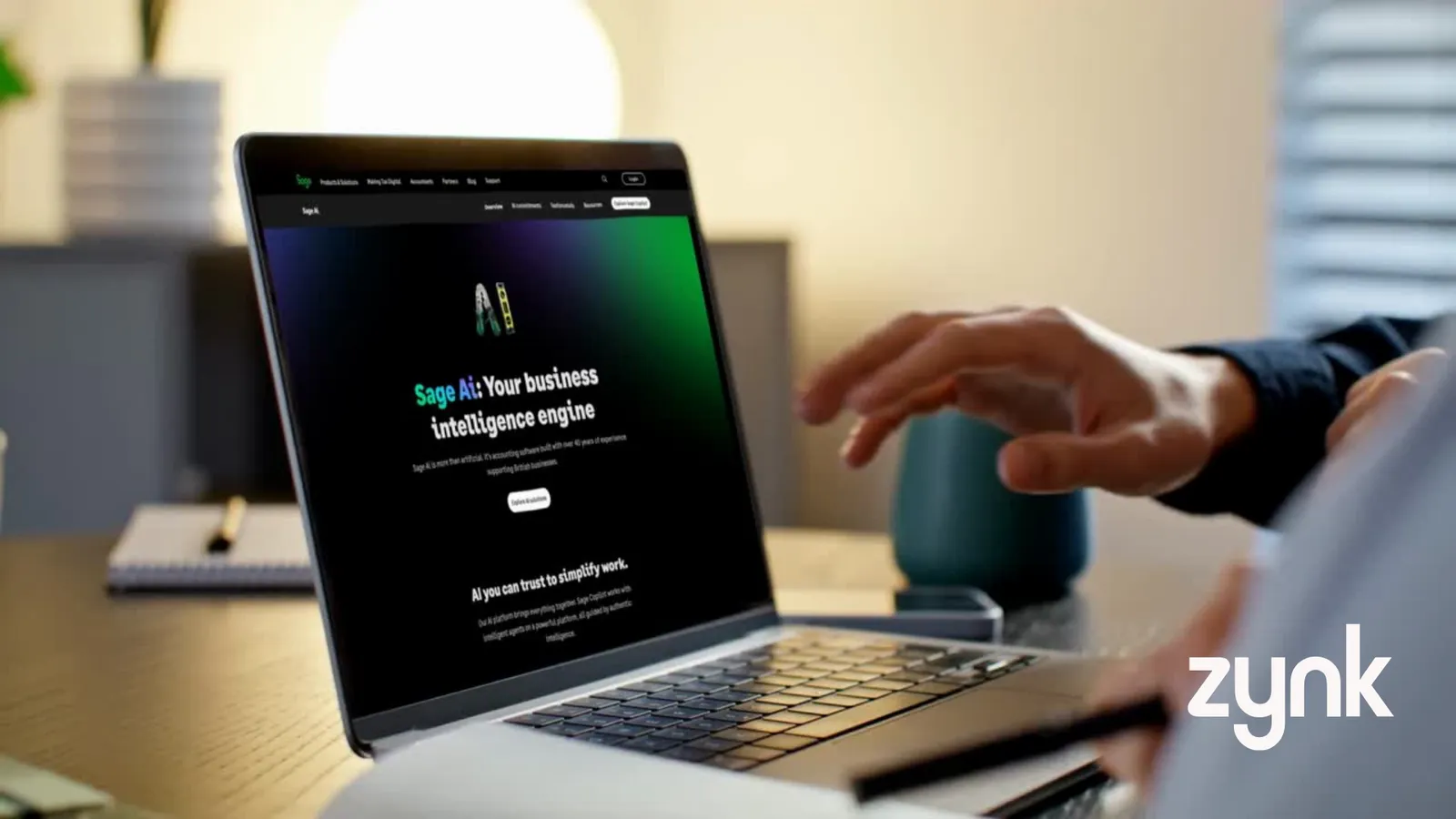
Sage AI now spans Sage Copilot, finance agents and a partner AI platform. Here is what is live today, what each part does, and what it needs from your data.
Sage AI is an umbrella term, and four different things sit under the name.
Sage Copilot is the conversational assistant embedded in the products. AI agents are the newer layer that can progress work rather than just describe it. The AI Gateway, Agent Builder and Agent Marketplace make up the developer platform for partner-built agents. And the AI Trust Label is the governance wrapper covering how AI is built and how data is used.
Underneath all of it is a domain-specific accounting and compliance model Sage developed with AWS, rather than a general-purpose assistant bolted onto a ledger.
Sage Copilot: the assistant layer
Sage Copilot was unveiled at Sage Transform in February 2024 as an AI-powered productivity assistant, handling repetitive admin, flagging errors and generating insights through natural language commands.
As of April 2026, Sage Copilot capabilities are expanding across Sage Intacct, Sage X3, Sage Accounting, Sage Active, Sage Operations, Sage 50, Sage Individual and Sage for Accountants. Through a natural-language interface it helps users interrogate financial data, automate tasks such as document capture and reconciliation, and surface recommendations to support decisions.
Sage Operations, previously Sage Distribution and Manufacturing Operations, got Copilot in January 2026, with Sales Insights giving teams a view of open orders and delayed deliveries so problems surface earlier.
What this means for you:
Sage Intacct Users: Focus on conversational interrogation of financial data, automating document capture, and receiving action-ready insights directly within your workflows.
Sage 50 & Accounting Users: Look forward to streamlined bank reconciliation and automated repetitive admin tasks to reduce manual entry.
Sage Operations Users: Utilize Sales Insights to flag open orders and delayed deliveries early.
AI agents: from insight to action
The bigger shift in 2026 is agentic. Sage's framing is that teams move from processing transactions to managing exceptions and acting on insights, while remaining accountable for what the AI does.
The Sage Intacct Finance Intelligence Agent is the centrepiece, rolling out in phases and scheduled for general availability later in 2026. Built on Sage's financial AI models, it takes natural language instructions and can prepare tasks such as payment reminders, approvals and write-offs inside existing workflows, with people keeping the final decision.
Two details matter more than the headline. Every recommendation comes with an explanation of the underlying data, logic and assumptions, so it can be interrogated rather than taken on faith. And every AI-driven action is logged, showing what was recommended, what was approved and by whom.
Elsewhere, Sage has introduced Sales and Operational Intelligence agents for Sage X3 to surface risks in sales performance and operational workflows, and an HCM agent covering workforce management, labour allocation and payroll compliance. IDC forecasts that by 2030, 45% of organisations will orchestrate AI agents across core business functions, so this direction is not unique to Sage.
The platform layer: AI Gateway, Agent Builder and the Agent Marketplace
Sage is also opening the platform up. AI Gateway, Agent Builder tools and a dedicated Agent Marketplace let partners and developers build specialised agents that plug into Sage data and customer workflows, including inside the Sage Copilot experience, subject to Sage certification standards. The gateway is built around a Model Context Protocol server, allowing multiple agents to coordinate tasks, retrieve information and generate insights.
For anyone planning a Sage roadmap, this is the part worth watching. Sage AI is becoming an integration surface in its own right, not just a feature inside the user interface.
Trust, auditability and the glass box approach
Financial systems need deterministic rules and an audit trail, which is why Sage describes its approach as a glass box rather than a black box: recommendations should be transparent, explainable and auditable.
That thinking also produced the AI Trust Label, which went live in Sage Intacct for US and UK customers in November 2025 as the first phase of a global rollout. It sets out trust indicators including compliance with global regulations, how customer data is used, and the systems monitoring accuracy and ethical performance, in language that does not assume a technical background.
Sage's own research explains why the company bothered. While 94% of small and mid-sized businesses already using AI report seeing benefits, 70% have yet to fully adopt it, and the difference is trust: 85% of those who trust AI actively use it, against 48% of those who do not.
Can you use ChatGPT or Claude with Sage?
Yes, and for many businesses it is the quickest way to put AI to work on their accounts. ChatGPT, Claude, Microsoft Copilot and Gemini can't see your Sage data on their own. They connect to business systems through MCP (Model Context Protocol), the open standard AI assistants use to reach outside data, and Sage's own AI Gateway is built around it too.
Insights AI, Zynk's Sage MCP server, connects Sage 50 and Sage 200 to the assistant your team already uses. It is read-only and works within your existing Sage permissions, so you can ask "which customers are more than 60 days overdue?" or "how do sales this quarter compare with last year?" without waiting for Copilot to reach your product and edition.
Two guides go further: how to connect Sage to ChatGPT, Claude, Copilot or Gemini, and is it safe to connect Sage to AI?
What does Sage AI cost?
It depends which Sage AI you mean:
- Sage Copilot is now available at no extra charge for all Sage Accounting users in the UK, and it's included for the users on a Sage 50 subscription (extra users cost more). For other products, Sage describes it as included in select plans or available as an add-on, so check your plan. Sage 200 isn't on Sage's list of Copilot products as of October 2026.
- Using ChatGPT or Claude with Sage means a connector plus a suitable assistant plan. Insights AI starts at £49 a month with no setup fees (see pricing), and you need an assistant plan that supports custom connectors, which our setup guide lists.
The benefits of AI in Sage
The useful benefits are practical rather than futuristic:
- Answers instead of reports. "Who owes us money, oldest first?" takes seconds, rather than running, exporting and filtering the aged debtors report.
- Faster month-end checks. Ask what moved against last month or last year, and which figures look unusual, before you close the period.
- Less admin. Copilot features such as document capture and bank reconciliation take repetitive keying off the team.
- Everyone can ask. Figures no longer depend on the one person who knows the report designer.
- Trends, not just totals. Spot customers who are paying more slowly, margins that are slipping or suppliers whose spend is creeping up.
Sage AI for accountants and finance teams
For finance teams, AI is mostly about management information on demand: debtor days, cash due in and out, sales against last year and the commentary that goes with them, without building the pack by hand each month.
For accountants and bookkeepers, Sage is building Copilot capabilities into Sage for Accountants, and an MCP server lets a practice interrogate a client's Sage data in plain English before a review or a year-end. In both cases the AI prepares and the person checks: the figures still need a professional's eye before anyone relies on them.
Where AI in Sage accounting is heading
As of October 2026, three things are clear. AI is moving from answering questions to preparing work, such as payment reminders and approvals, with people approving the result. Open standards like MCP mean you can choose the assistant, rather than being tied to the one built into your accounts package. And the quality of the data underneath matters more, not less, because an AI answer is only as good as the ledger it reads.
To see the options side by side, read Sage AI tools compared.
Limits and gotchas to plan for
Availability varies. Product, region, edition, subscription and early adopter status all affect what you can actually turn on, so confirm before promising a capability internally.
Phased releases are not finished products. The Finance Intelligence Agent is scheduled for general availability later in 2026, so an early adopter deployment is a different commitment to a settled feature.
Accountability stays with people. Agents prepare and recommend, humans approve. The audit trail exists precisely because someone still owns the outcome.
It only knows what is in Sage. This is the big one, and it is covered next.
Why your data decides whether Sage AI is useful
Sage AI reads the data in your Sage system. If your orders sit in an eCommerce platform, your customers sit in a CRM, your stock movements sit in a warehouse system and your payments arrive in a marketplace report, then none of that exists to Sage AI until it lands in Sage.
The failure mode is quiet rather than dramatic. Copilot will still answer, the agent will still recommend, and the output will look confident while resting on data that is a week old or missing a channel entirely. Anomaly detection cannot flag an anomaly in a transaction that never arrived. A cash flow view is only as accurate as the last sync.
There is a second problem: consistency. If the same customer exists three times, if nominal codes are applied differently by whoever keys the batch, or if tax treatment varies by channel, AI will faithfully reflect that mess back to you.
Where deterministic integration fits
AI is probabilistic. Moving financial data should not be. The two work best in that order: a deterministic layer that puts complete, consistent, timely data into Sage, and an AI layer that interprets it.
That is the layer Zynk handles. To support Sage’s "glass box" approach, financial teams need complete trust in their audit trail. Zynk acts as the foundation of this trust. With 100+ connectors, including Sage 50, Sage 200, and Sage Intacct alongside eCommerce, CRMs, and marketplaces, Zynk runs workflows deterministically. This guarantees that your source data is integrated perfectly, ensuring the explanations, logic, and recommendations generated by Sage AI are reliable, accurate, and completely auditable. Teams using Zynk save up to 29 hours per month on manual entry while keeping their AI models properly fueled.
Zynk is a low-code integration platform that lets you integrate your systems far faster than a custom build.
Talk to an integration expert
If Sage AI is on your roadmap, the critical first step is ensuring your systems are feeding Sage the complete, high-quality picture. Our integration experts connect Sage to your eCommerce platforms, CRMs, marketplaces, and bespoke systems every day.
Book your 15-minute Sage AI Readiness Call with Zynk today for a quick compatibility check to ensure your data is ready for the Sage AI future.
Frequently asked questions
Is Sage AI the same as Sage Copilot?
No. Sage Copilot is the assistant you interact with. Sage AI is the wider umbrella, covering Copilot, the AI agents, the developer platform and the governance framework around them.
Which Sage products have Sage Copilot?
As of April 2026, Sage Copilot capabilities are expanding across Sage Intacct, Sage X3, Sage Accounting, Sage Active, Sage Operations, Sage 50, Sage Individual and Sage for Accountants, with capabilities differing by product.
Is the Sage Intacct Finance Intelligence Agent available now?
It is being released in phases, with general availability scheduled for later in 2026. Check your region and subscription before planning around it.
Does Sage AI remove the need for integration?
No. Sage AI works on the data held in Sage, so anything living in another system still has to get there, accurately and on time, before AI can do anything with it.
Is there an AI tool for Sage?
Yes, several. Sage Copilot is built into a growing list of Sage products. MCP servers such as Insights AI connect Sage 50 and Sage 200 to Claude, ChatGPT, Copilot or Gemini. BI tools and report writers work from Sage exports. Sage AI tools compared sets out which fits which need.
Can ChatGPT read my Sage data?
Not on its own. ChatGPT, Claude and other assistants need an MCP server to reach your Sage data. Insights AI is one: it gives the assistant read-only access to Sage 50 or Sage 200, within your existing Sage permissions. See how to connect Sage to ChatGPT and Claude.
Can I trust Sage AI with financial data?
Sage publishes its AI Trust Label, live in Sage Intacct for US and UK customers since November 2025, covering regulatory compliance, data use and accuracy monitoring, and logs AI-driven actions so recommendations and approvals are traceable.
Automate your way to success with Zynk
Take the first step towards effortless automation.
Get in touch